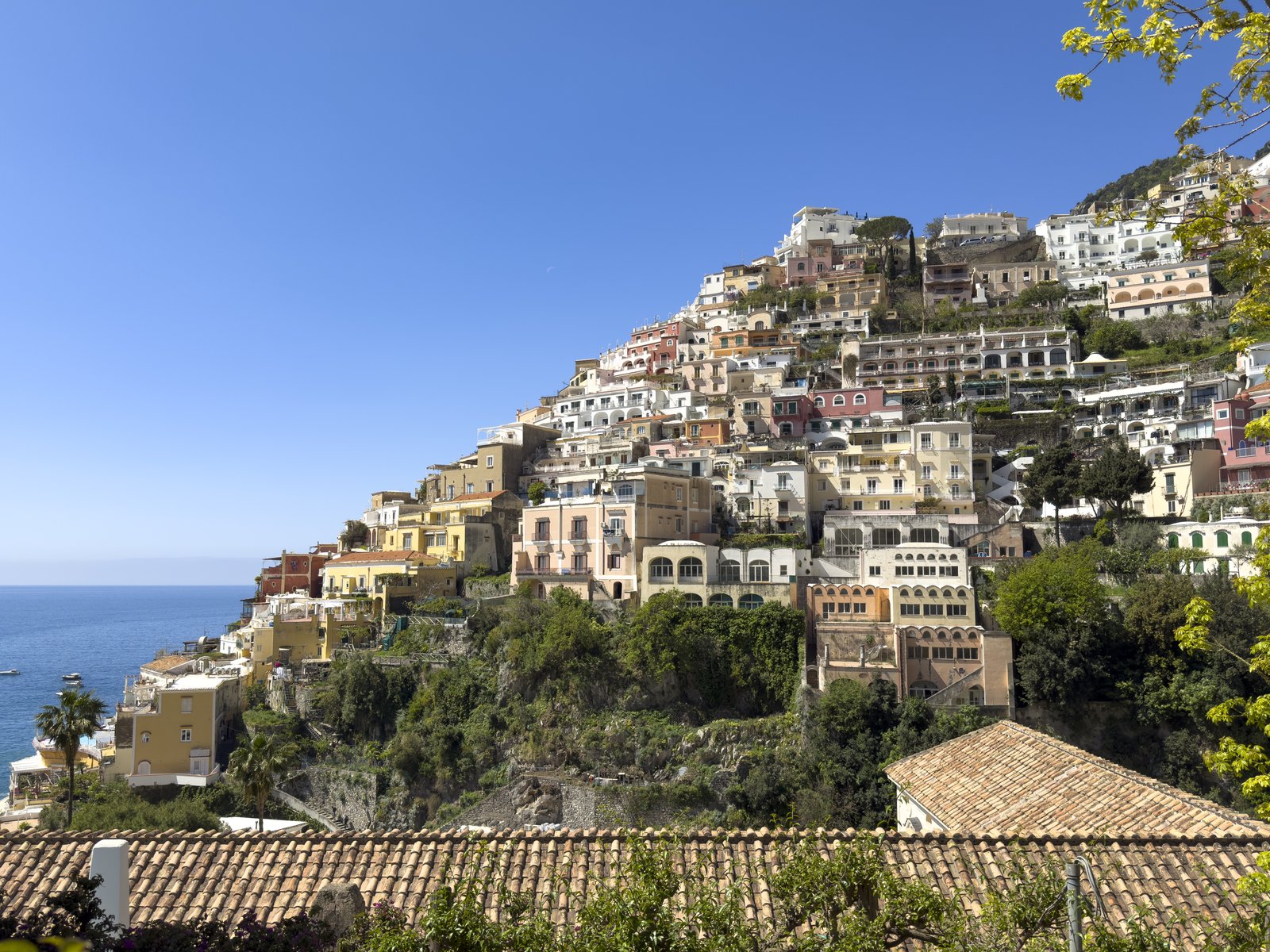
The Amalfi Coast
Stay in Positano, swim before the beach fills, and let the boat do the work the coast road makes difficult. The coast rewards a rhythm set by the water.
Notes from Elsewhere · Published November 2026 · Updated November 2026
Photograph: Alexis Lours, via Wikimedia Commons
The Costiera Amalfitana runs along the southern coast of the Sorrentine Peninsula in the province of Salerno, where the Lattari Mountains divide the Gulf of Naples from the Gulf of Salerno. UNESCO inscribed the coast as a World Heritage cultural landscape in 1997. The listed area covers 11,231 hectares, encompassing 15 municipalities, agricultural land and three natural reserves: a landscape shaped equally by nature and by the people who learned to live on steep ground.
That work is visible in the terraces. UNESCO records citrus groves and vineyards grown wherever a suitable spot could be found, terrace cultivation on the lower slopes, drystone walls holding the ground in place, and grazing on the upper land. In the towns, the same adaptation produced narrow streets and steep stairs. Its beauty comes from that long negotiation with the slope.
Positano makes the best base because it shows the pattern at its clearest. Italia.it, the national tourism portal, calls it a vertical village, perched on rock above the sea, its white houses sloping down toward the water. At the foot of the village stands the Church of Santa Maria Assunta, a short walk from Marina Grande beach, with a pale stone facade, a dome of yellow, green and blue majolica, and a Byzantine icon inside. Stay here, and the dome, seen from the water, is the fixed point that tells you where home is.
Begin with the water, and begin early. Swim before eight, while Marina Grande, which Italia.it measures at 400 metres of shore and calls the town’s most famous beach, is still in its morning order. Later, walk on to Fornillo, a cove of pebbles and gravel, or take a small boat toward the Li Galli archipelago, three small islands in a marine reserve. The coast is at its most generous before the day’s traffic has built up.
Take the boat, not the road, to Amalfi. Travelmar lists continuous departures to the ports of Positano, Amalfi, Atrani, Minori, Maiori, Cetara, Vietri sul Mare and Salerno, and arriving by sea puts you at the foot of the town, facing the cathedral. Its monumental complex includes the Crypt of St Andrew, the Diocesan Museum in the Basilica of the Crucifix, and the Cloister of Paradise, built between 1266 and 1268 as a burial place for Amalfi’s noble families, its intertwined arches set around a Mediterranean garden. Lunch after that, and the return boat in the afternoon, is the coast working as it should.
The alternative explains the preference. The SS163, the state road maintained by ANAS, runs for 50.36 kilometres between Sorrento and Amalfi, much of it carved out of the coastal cliffs. Travelmar itself sets the ferry against the always busy route 163 and its sharp turns, and UNESCO lists vehicular traffic among the pressures on the area. The boat gives the same cliffs back as scenery, which is what they are for.
The towns
UNESCO names Amalfi, Atrani, Reginna Maior and Reginna Minor as the main coastal areas, with Positano, Praiano and Cetara among the secondary areas, and Scala, Tramonti and Ravello as characteristic villages.
Between the 9th and 11th centuries the Amalfi Sea Republic held great power, and its architecture fuses eastern and western elements in the Arabic-Norman style.
The water
Marina Grande is the morning address: 400 metres of shore beneath Positano, with the pier for boats to the other towns and toward Li Galli.
Fornillo, reached on foot, is a quieter cove of pebbles and gravel. Swim early, walk later, and let boats do the distances in between.
The road, avoided
The SS163 is 50.36 kilometres of cliff road between Sorrento and Amalfi. It connects every town, and it asks full attention for the whole drive.
From Salerno, Travelmar ferries leave from Molo Concordia, a 10-minute walk from the station. For a stay, the boat is the sensible road.
A note on rhythm. Arrange the day around the water rather than the road: an early swim, a boat to lunch, a town taken on foot in the afternoon. Positano as a base, Amalfi as the destination, and the sea as the connection is the coast’s own logic, followed.
More places, taken slowly
Gstaad after the lifts close, Megève skied slowly, and other places the Maison returns to.
Back to Places