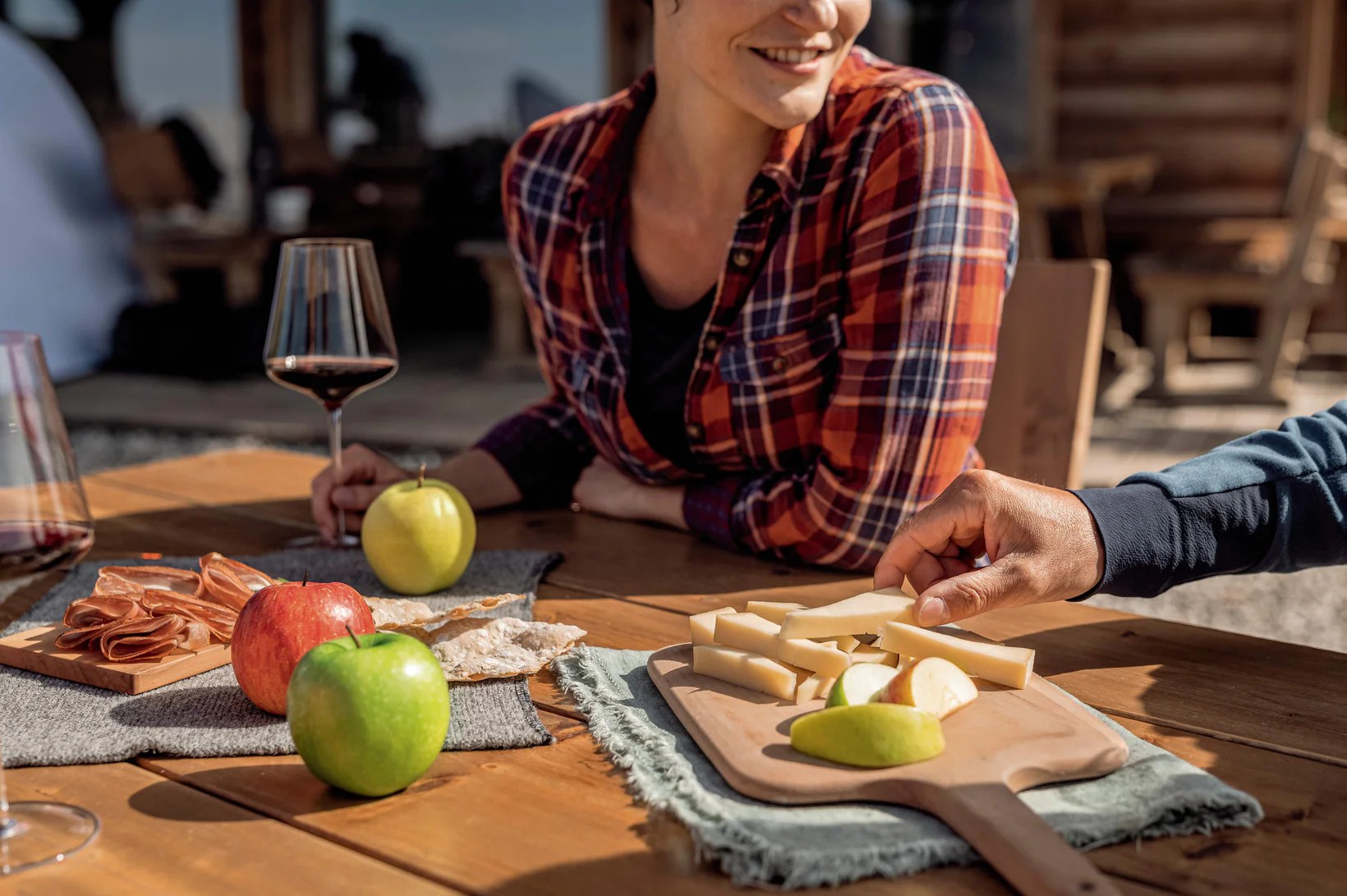
The farm table, South Tyrol
Dinner in a working farmhouse kitchen, where the menu is the holding itself and the cooking begins months earlier, in the fields outside the door.
Experiences · Published November 2026 · Updated November 2026
Photograph: IDM Südtirol-Alto Adige, via suedtirol.info
South Tyrolean agriculture is small in scale. That fact, stated plainly by the Südtiroler Bauernbund, the Farmers’ Association, explains much about the region’s table: a holding rarely supports a family on farming alone, so the farm does several things well at once. It farms, it cooks, and it receives guests, and each activity supports the others.
Roter Hahn, Red Rooster, the quality brand the Farmers’ Association created in 1998, holds this together. It brings five pillars under one mark, from farm holidays and farm products to farm taverns and a cookery school. More than 1,600 holiday farms belong to the scheme, and strict criteria with regular checks are the condition of carrying the rooster.
The farms change with altitude. In the lower valleys, along the Etsch river and the southern wine routes, the holdings sit among vineyards and apple orchards. Higher up, towards the Dolomites and the Ortler massif, dairy farming and livestock take precedence. In either landscape, what guests enter is a working farm first. Its central room is the Stube, the wood-panelled parlour where guests and hosts gather to share meals and stories.
The farmhouse inns and wine taverns under the Roter Hahn mark cook to a written standard, and it is a demanding one. Eighty per cent of the products are from South Tyrol, and thirty per cent directly from the farm itself. Every dish is home-made, the menu offers only rural dishes, and there are at least three home-made juices and cordials. The two forms are distinguished by what the holding produces: a Buschenschank, a wine tavern, serves only wines from its own vineyards, while a Hofschank, set above the wine-growing area, makes its meat dishes only with meat from its own farm.
That standard is why the farm table cannot be separated from the farming year. Roter Hahn describes dishes adapted precisely to the season, from products that have travelled no further than from the field to the Stube. In spring the planting lays the menu’s foundation: cabbage and tomatoes, seed potatoes, lettuce and herbs. By late summer the potatoes are harvested, and fruit and berries become juices, syrups and the jams that fill the doughnuts. Cabbage comes fresh as a salad with bacon dumplings, and fermented as sauerkraut beside home-made sausages, each farm’s version tasting slightly different.
In autumn the custom reaches its fullest form in Törggelen, the harvest season from early October to late November. The word comes from the Torggl, the wooden wine press in the farmers’ cellars, and in turn from the Latin torquere, to twist. The feast began, the official South Tyrol site records, as the farmers’ thanks to their harvest helpers. It still follows the old shape: barley soup or Schlutzkrapfen to begin, then roast meat and home-made sausages with dumplings and sauerkraut, and a sweet finish of Krapfen and roasted chestnuts, with fresh grape must and young wine. Farms in Authentic Törggelen hang a bouquet, a Buschen, with a red ribbon on the door, and all fulfil the Red Rooster quality criteria.
The appeal is its honesty. A small table and a single menu are not a limitation; they are the natural consequence of a kitchen that cooks what one holding, in one season, can produce well. To sit at such a table is to eat the farm as it is that week, and there is a generosity in that directness a longer menu rarely matches.
The farm
A working holding before it is anything else, one of more than 1,600 Roter Hahn holiday farms, on wine, fruit and livestock farms alike.
Income from guests helps the family live from the farm all year round.
The kitchen
At the Roter Hahn inns, 80 per cent of products are from South Tyrol, 30 per cent directly from the farm, and every dish is home-made.
Every farmhouse inn offers at least one meat dish from its own production, made to old recipes.
The season
The menu is written by the year: planting in spring, fruit and berries preserved in late summer and autumn.
From early October to late November, Törggelen turns the harvest into a feast of new wine, roasted chestnuts and farmhouse dishes in the Stube.
Take the season as it comes. An autumn evening ending with chestnuts roasted over the fire, the Keschtnfeuer, is the farm table at its most complete, and the Eisacktal valley Chestnut Trail, 90 kilometres from Vahrn to Schloss Runkelstein near Bolzano, walks through the country that produces it.
Continue in Experiences
Tables, journeys and seasons, considered at the pace they deserve.
All experiences