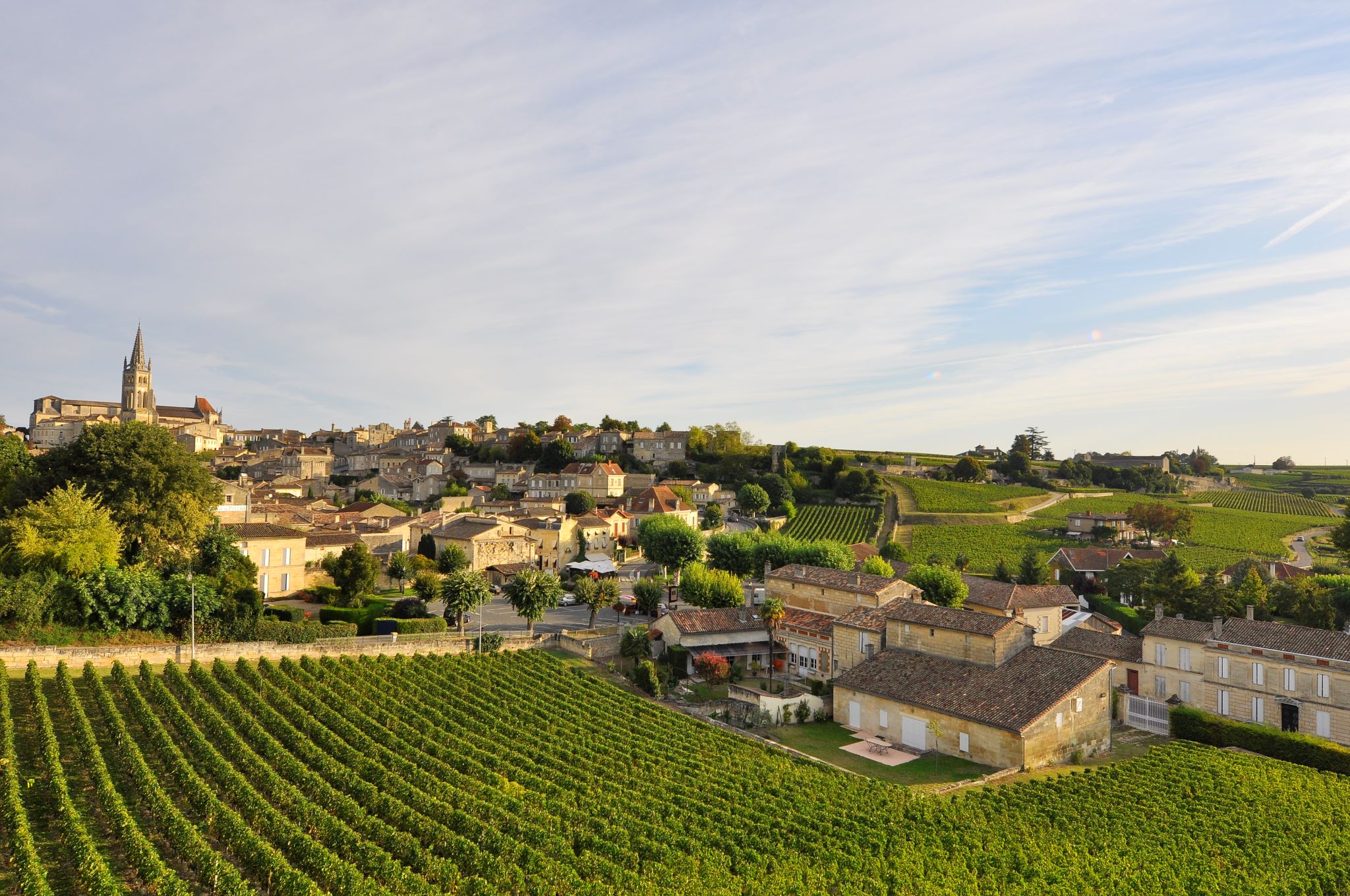
Harvest week, Saint-Émilion
Five days between the rows and the chai in a vineyard landscape listed by UNESCO in 1999, ending at the long table the picking team sets for itself on the last evening.
Experiences · Published November 2026 · Updated November 2026
Photograph: Saint-Émilion Tourisme
Some wine country is scenery. Saint-Émilion is a working landscape, and it has been one for a very long time. Viticulture was introduced to this fertile part of Aquitaine by the Romans and intensified in the Middle Ages, when the area benefited from its place on the pilgrimage route to Santiago de Compostela and churches and monasteries rose from the 11th century onwards. The Jurisdiction established in the 12th century covers 7,847 hectares in the Gironde, bounded by the Dordogne to the south and the Barbanne stream to the north: plateau, hillsides and plain, given over to vines across eight communes.
UNESCO recognised what that continuity means. On 2 December 1999 the Jurisdiction of Saint-Émilion was inscribed on the World Heritage List as a cultural landscape, the first vineyard to be so listed. The grounds, as UNESCO states them, are twofold: an outstanding example of a historic vineyard landscape that has survived intact and in activity to the present day, and an exceptional illustration of the intensive cultivation of grapes in a precisely defined area. Within it lie approximately 5,000 hectares of vines.
Harvest week is when that landscape stops being a view and becomes a workplace at full stretch. September is the turning point of the Saint-Émilion year, decided not by habit but by ripeness. The Jurade's own account of the old discipline is plain about the principle: experts were sent into the vineyards to make sure the grapes would be fully ripe when the harvest was proclaimed, because the final goal was the quest for quality. The rows are picked in that spirit still, parcel by parcel.
From the rows, the work moves a short distance indoors. UNESCO's description of the Jurisdiction notes the chai, the wine storehouse, as one of its characteristic buildings: a large rectangular functional structure in stone, or a mixture of brick and stone, with a tiled double-pitched roof. In harvest week the chai is the second half of every day, where the picked fruit arrives, is sorted and begins its passage from grape to wine, and where the pace changes from the open rhythm of the rows to something closer, quieter and exact.
Over the whole week presides an institution older than the town's fame. The Jurade came into being in 1199, when King John Lackland signed the Charter of Falaise and delegated economic, political and judicial powers for the administration of Saint-Émilion. Its charges came to centre on wine: it supervised the production of fine wines, held the vintners' brand burnt onto each barrel, acted against fraud and destroyed wine judged unworthy. Above all, it checked that the grapes were ripe and determined the date the harvest could begin. Dissolved during the French Revolution, the Jurade was revived by the winegrowers in 1948, and keeps its two great Chapters of the year, in spring and at the harvest.
And then, the work done, the week closes at the table. The long table the picking team sets for itself on the last evening is not a performance for visitors. It is the harvest feeding its own, the rows and the chai gathered into one meal, in a town whose Wine Council speaks for four appellations: Saint-Émilion, Saint-Émilion Grand Cru, Lussac Saint-Émilion and Puisseguin Saint-Émilion. After five days of ripeness judged and fruit carried in, a table like that needs no ceremony beyond its own length.
The rows
Approximately 5,000 hectares of vines spread across the eight communes of the Jurisdiction, on plateau, hillside and plain.
Picking follows ripeness, parcel by parcel, as the old rule required: experts in the vineyards first, confirming the grapes were fully ripe.
The chai
The chai, the stone wine storehouse with its tiled double-pitched roof, is where the day's second shift happens.
Fruit arrives from the rows to be sorted and begun on its way to wine.
The proclamation
On the third Sunday in September the harvest is proclaimed from the top of the King's Tower, the 13th-century keep.
The Ban des Vendanges was historically the authorisation to begin picking: the lifting of the ban on grape harvesting, a public decision taken in the general interest.
Time a September visit to the third Sunday of the month, when the Jurats parade in their bright red robes and the proclamation is made from the King's Tower: eight centuries of harvest discipline, visible in a single procession.
Continue in Experiences
Tables, journeys and seasons, considered at the pace they deserve.
All experiences