Lofoten under canvas
Four days under sail among the Lofoten Islands, from Svolvær to Trollfjorden and the fishing villages, in an archipelago that has always been read best from the water.
Notes from Elsewhere · Published November 2026 · Updated November 2026
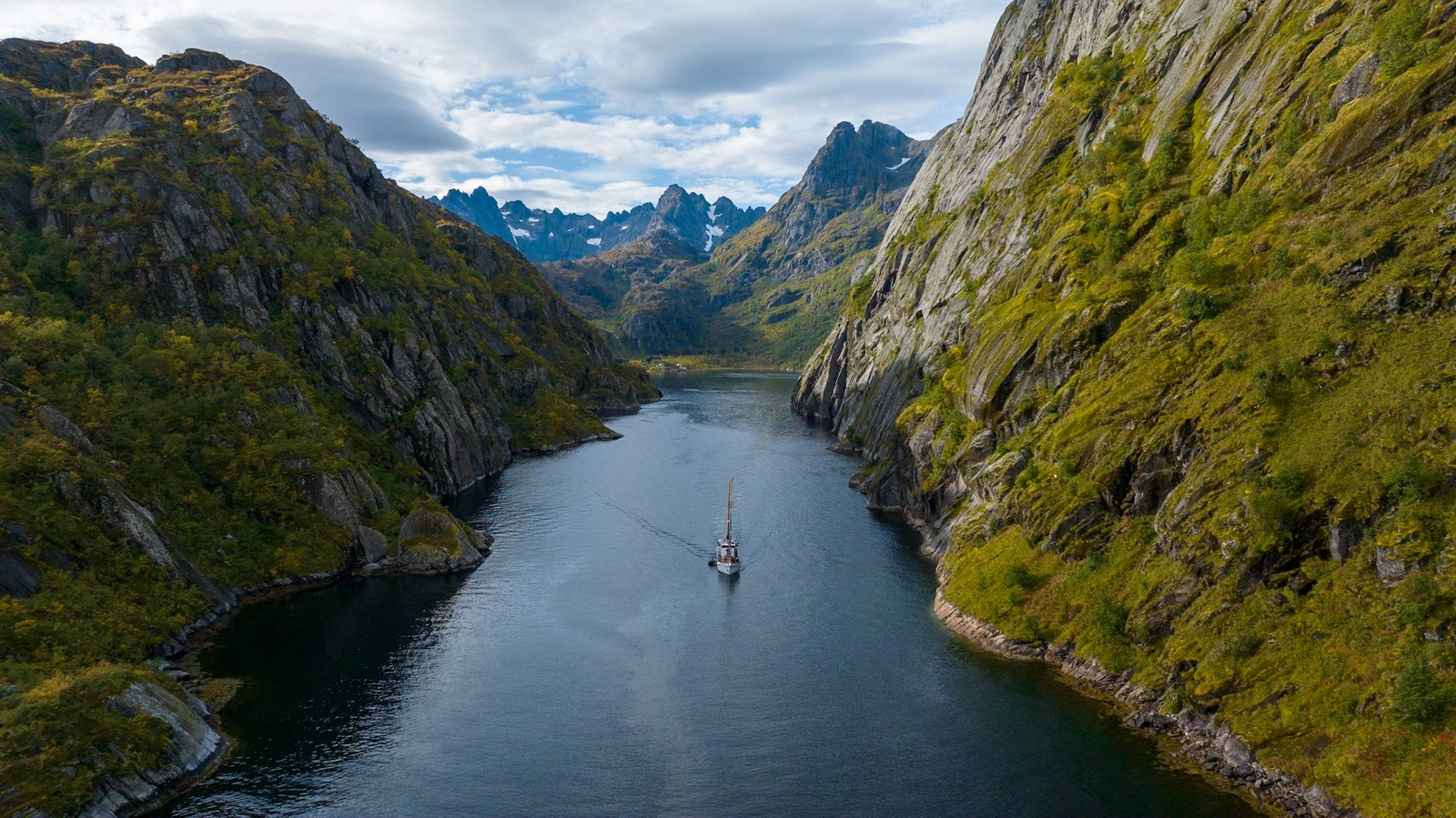
Photograph: World Sea Explorers, S/Y Stella Oceana in Trollfjorden
From the sea, Lofoten makes a different kind of sense. The archipelago stands in the Norwegian Sea above the Arctic Circle, at the 68th northern parallel, and its mountains rise straight out of the water in a long wall. Read from a deck, the islands arrive as they were first known: as shelter, as harbour, as a place to land fish. The form of trip that suits them best is a short one taken slowly, four days on a 62-foot sloop, routed by weather and appetite alone.
The chain is compact. Five main islands, Austvågøya, Gimsøya, Vestvågøya, Flakstadøya and Moskenesøya, form its spine, with many smaller islands and skerries around them. Vestfjorden lies between the islands and the mainland, and the open sea works on the outer side. Between the peaks lie sheltered bays, small harbours and the fishing villages, Reine, Nusfjord, Henningsvær and Å among them.
Fishing built this coast. Since the Viking Age the islands have been a centre for Norwegian Arctic cod, or skrei, which come here to spawn in the winter months, and the villages grew around that season. The rorbu, the fishermen's cabins at the water's edge, were lodging for the men who came for the Lofotfiske season from February to April. Along the harbours the racks of drying stockfish still stand, and a sailing route passes them at walking pace.
Sailing is how the destination itself presents the islands. Visit Lofoten describes the crossing of Vestfjorden with the Lofoten Wall rising from the horizon, sheltered bays and fishing villages appearing as the boat comes closer, and the freedom to anchor for a hike, stop for a swim, try fishing, or keep sailing when conditions are good. Local programmes are written the same way, as a starting point to be adapted to weather: south from Svolvær toward Reine and Nusfjord, north through the tidal current of Nappstraumen, around to Skrova, and into Raftsundet and Trollfjorden.
Trollfjorden is the narrow heart of it. The fjord is only 100 metres wide at its opening, there is no road into it, and the only way in is by boat. White-tailed sea eagles work the water around Raftsundet and the fjord, the bird Visit Norway calls Northern Europe's largest bird of prey; local safari operators give its wingspan at up to 2.65 metres.
Then there is the light, which is the real itinerary. In summer the midnight sun keeps the islands bright through the night, and a four-day route can be planned around anchorages rather than darkness. In autumn the northern lights return; Visit Lofoten gives their season as September to April. Either way, meals, hikes and anchor watches arrange themselves around the sky instead of the clock.
The archipelago
Start at Svolvær, the harbour town on Austvågøya, and let the islands come in order. The distances are short; the mountains are not. What looks near on the chart still takes a morning under sail, and that is the correct pace.
The villages reward arriving by water. A harbour entrance explains a place faster than a car park does.
Under sail
Plan the route loosely, and keep it that way. Sailing operators in the islands adapt their programmes to weather as a matter of course, and a sloop has even less reason to keep an appointment with a fjord.
Anchor where the evening is best: off Skrova, in a sheltered bay, or alongside in Nusfjord or Henningsvær, with a hike, a swim or a line over the side before dinner.
The light
Go in June for the fullest version. June falls within the brightest midnight sun season, and the night becomes extra sailing time rather than an end to the day.
For the northern lights, the season runs from September to April. That is a colder, darker Lofoten, and a fine one, but it is a different voyage.
A note on appetite, since it is half the routing. These are fishing villages, and the table follows the harbour: fish from these waters, stockfish as it has been prepared here for generations, and dinner timed to the anchorage rather than the other way round. A route decided by weather and appetite is not an absence of planning. In Lofoten, it is the oldest form of it.
The sea, taken slowly
Heli-skiing in Livigno, the Stelvio at dawn, a harvest dinner in the rows, and more.
All experiences