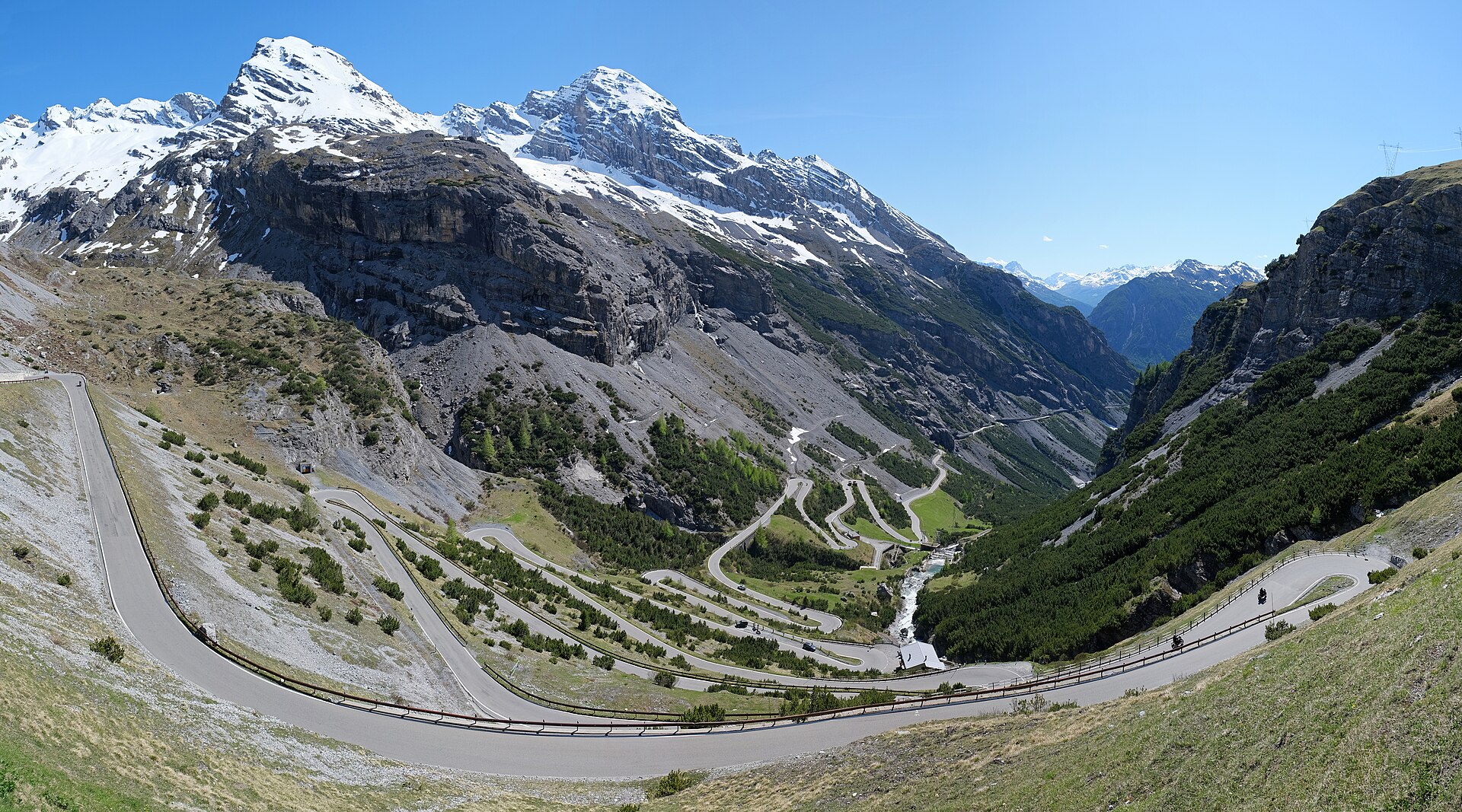
The Stelvio at dawn
The pass itself, before the day gathers: a road of 1825 above Bormio, 88 hairpin bends drawn across one mountain, and a summit at 2,758 metres that is best reached early.
Experiences · Published November 2026 · Updated November 2026
Photograph: kallerna, via Wikimedia Commons
Some roads are a means of arriving. The Stelvio is a place in its own right, a line drawn back and forth across a mountainside until the drawing itself became the destination. It joins the Valtellina, in Lombardy, to the Val Venosta, in South Tyrol, and at 2,758 metres it is the highest car pass in Italy and the second highest in Europe. In the first hour of the day the road reads most clearly: bend after numbered bend, climbing out of the valley shade towards the Ortler, which stands at 3,905 metres above the pass.
The road was a military idea before it was anything else. Commissioned by the Austrian Emperor as a route linking Vienna and Milan, it was inaugurated in 1825. The project was entrusted to the engineer Carlo Donegani, and the road built between 1820 and 1825 has kept its essential line ever since: a steady gradient won from a steep mountain by the simple, repeated device of the hairpin bend. Today it is the Strada Statale 38, but the engineering is still Donegani's, and it is best understood slowly, at the pace the bends impose.
The two faces have different characters. From Bormio, the climb is 21.5 kilometres long, rises 1,533 metres and counts 40 bends, with tunnels cut into the mountainside along the way. It is the more open face, the valley falling away as the road gains height. The South Tyrol face, down towards Prato allo Stelvio, is the famous wall: 48 tight hairpin bends, numbered, stacked one above another so closely that the road seems to fold over itself. Together the two faces make 88 hairpin bends, and from the summit each can be read like a diagram of the other.
The pass sits within the Stelvio National Park, which surrounds the road on every side and was established in 1935. That setting explains the pass's double life. It is a working summer road, open from May to November and closed through the winter months, and it is also high mountain country: trails start at the pass itself, one of them reaching the Garibaldi peak at 2,843 metres, and skiing continues on the glacier through the summer. The road crosses the park; it does not tame it.
Cycling has given the pass its modern fame. The Giro d'Italia first crossed the Stelvio in 1953, and the summit has been the race's Cima Coppi, its highest point, no fewer than twelve times on Bormio's count. Once a year, towards the end of August, the road is closed to motorised traffic altogether and left to cyclists: a road built for an empire's armies, now handed over to bicycles.
Go early, then. The practical advice is the advice this road has always rewarded: leave Bormio by six, while the pass road is near empty and the light is still arriving, and let the climb take the time its 40 bends require. Take coffee at the summit without hurrying the descent. The car chosen for this road is considered in the companion piece in Garage; here the subject is the pass itself, and the pass, at dawn, needs nothing added to it.
The road
Commissioned by the Austrian Emperor to link Vienna and Milan, designed by the engineer Carlo Donegani and inaugurated in 1825.
Now the Strada Statale 38, it remains a single, deliberate line: height gained by hairpins, not by steepness alone.
The faces
From Bormio. 21.5 kilometres, 1,533 metres of climbing and 40 bends, through tunnels cut into the mountainside.
From Prato allo Stelvio. 48 tight, numbered hairpin bends on the South Tyrol face, beneath the Ortler at 3,905 metres.
The early hour
Leave Bormio by six and the road is near empty, the bends unhurried and the summit quiet.
Towards the end of August the pass closes to motorised traffic for a day and belongs to cyclists alone.
A note on timing. This is a summer road in the full sense: open from May to November, closed from November to the end of May, and always subject to the mountain's weather. The early start is not a stunt. It is simply the hour at which the Stelvio is most itself, before the day's procession begins.
Continue in Experiences
Roads, crossings and early starts, considered one at a time.
All Experiences