The three corniches
Nice to Monaco by the Grande Corniche at dawn, Èze for coffee, and back along the Basse Corniche after lunch. One coastline, three altitudes.
Experiences · Published November 2026 · Updated November 2026
Photograph: Tobi 87, via Wikimedia Commons
East of Nice, the Maritime Alps come down to the sea so steeply that one road was never going to be enough. Three were built instead, running in parallel between Nice and Menton at three different altitudes: the Basse Corniche along the water, the Moyenne Corniche halfway up the mountainside, and the Grande Corniche along the ridge above them both. It is the same short stretch of coast, read three ways, and the pleasure of the day is in the reading.
The better approach is a loop that uses all three roads, in the order the light suggests. Take the Grande Corniche eastbound at dawn, when the ridge is quiet and the sea below is still flat and pale. Come down to Èze on the Moyenne for coffee. Reach Monaco late in the morning, take lunch there slowly, and return west in the afternoon along the Basse, at sea level, with the day's last light on the water rather than behind the mountain.
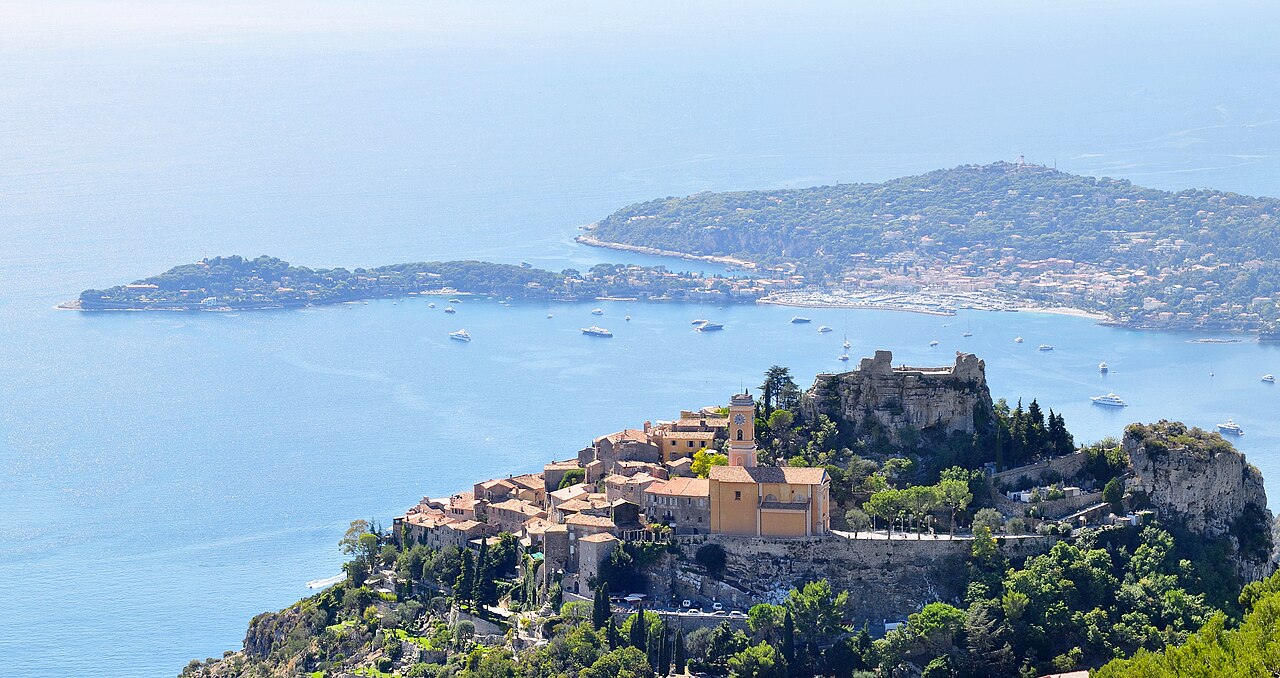
Èze is the hinge of the day, and it rewards the early start. The medieval village stands between Nice and Monaco, around ten kilometres from Nice, and the road that serves it is the Moyenne Corniche, running halfway up the slope. Below it, at the water's edge, sits Èze-sur-Mer on the Basse Corniche; above it, the Grande Corniche crosses the ridge. Few villages make the three-altitude arrangement so legible.
At the top of the village, the Exotic Garden is laid out in the ruins of a medieval fortress, 429 metres above the sea. Its southern terraces are given to succulents from dry regions of several continents; the northern side is a Mediterranean garden of grottoes and garrigue planting. From the summit the panorama runs along the Mediterranean as far as Saint-Tropez. Go up before the middle of the morning, while the lanes below are still quiet.
The high road has a landscape of its own worth pausing for. The departmental park of the Grande Corniche covers 712 hectares across the communes of La Trinité, Villefranche-sur-Mer, Èze and La Turbie, running from Mont Leuse to Mont Bataille. The forts of La Revère and La Drête were built between 1882 and 1885 for the protection of Nice. On a clear day the coast unfolds from San Remo to Saint-Tropez, the Mercantour rises inland, and Corsica can sometimes be seen.
The return along the Basse Corniche is a different coast altogether. Where the Grande Corniche looks down on the lie of the place, the Basse moves through it at street level, passing through Villefranche-sur-Mer, Beaulieu-sur-Mer, Èze-sur-Mer and Cap d'Ail on the way toward Monaco. Harbours, bathing places and station platforms follow one another without a break, and the afternoon is the right time for it: a slower pace, a stop for a swim or a coffee, and no hurry to be back in Nice before evening.
The Basse
The sea-level road, and the return leg. It runs along the coast through the harbours and bathing towns, closest to the water and to the railway line that shares the shore.
Take it after lunch, westbound, and stop where the light is best rather than where an itinerary says.
The Moyenne
The middle road, halfway up the mountainside, and the road to Èze village. It gives the coast in section: the Basse and the sea below, the ridge of the Grande above.
Mid-morning is its hour, arriving in Èze for coffee and the climb to the Exotic Garden.
The Grande
The ridge road, highest of the three, crossing the departmental park above Èze and La Turbie. The widest panoramas of the day are from up here.
Take it first, at dawn, eastbound toward Monaco, while the road is quiet and the air is clear.
A note on seasons. Spring and early autumn suit the loop best: the light is long enough for a dawn start without a punishing one, the three roads carry their ordinary traffic rather than the full weight of summer. In high summer the same day still works, but it should start earlier and forgive itself more stops.
One coastline, three altitudes
Roads, railways and slow journeys, arranged the way the Maison would take them.
All experiences