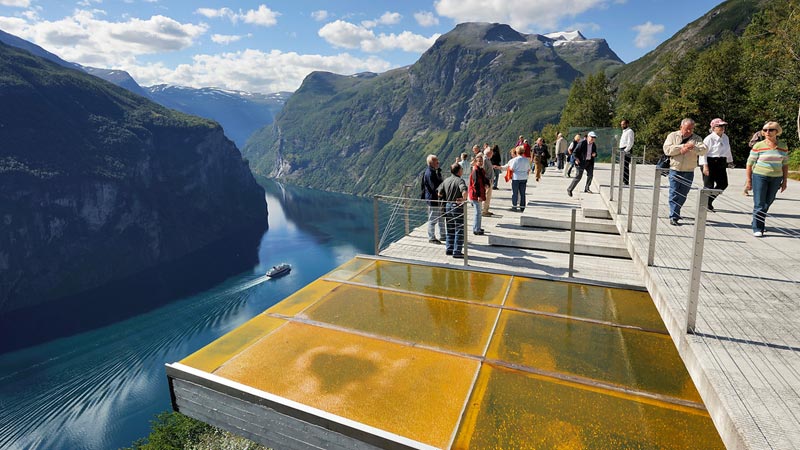
Geirangerfjord, before the ships
The case for May: the snowmelt is in the waterfalls, the scenic route north is newly open, and the summer traffic has not yet filled the fjord.
Notes from Elsewhere · Published November 2026 · Updated November 2026
Photograph: Visit Geiranger AS
The Geirangerfjord is a branch of the Storfjord in western Norway, running 20 kilometres between Hellesylt and the village of Geiranger at its head. In 2005 UNESCO inscribed it, together with the Nærøyfjord 120 kilometres away, as the West Norwegian Fjords. The listing describes rock walls that rise up to 1,400 metres from the water and extend 500 metres below sea level, and fjords that vary in breadth from 250 metres to 2.5 kilometres.
Geiranger village sits at the inner end of the fjord. The first stop is the Norwegian Fjord Centre, the visitor centre for the World Heritage site, which sets out the geology of the fjord and the history of the farms along it. In May the village is quiet, and belongs briefly to the people who live there and the few who have come early.
The waterfalls are why May matters. The Seven Sisters fall in seven streams beside the abandoned farm at Knivsflå, with an average fall of around 250 metres. Opposite them stands the Suitor, and further along the Bridal Veil. Fjord Norway notes that the falls depend on snow thaw and rain, and show most clearly in the snow melting period from May to July. Come in May and they are full, white against dark rock, best seen from a boat on the fjord itself.
The road tells the same story of timing. The Norwegian Scenic Route Geiranger–Trollstigen runs 104 kilometres between Åndalsnes and Geiranger and is usually open from mid-May to October or November, closed through the winter. To arrive from the north in May is to take the route in its first, emptiest weeks, when the hairpins carry little traffic and snow still lies on the high ground. The scenic routes authority itself warns that traffic is heavy in high season.
Two viewpoints repay the climb above the village. The Eagle Road, Ørnevegen, leaves Geiranger toward Eidsdal in 11 hairpin bends, reaching 620 metres above sea level at Korsmyra; opened on 15 September 1955, it gave the village year-round road access. At Ørnesvingen, the highest bend, the panorama takes in the village, the fjord, the Seven Sisters and Knivsflå below. On the other side of the village, Flydalsjuvet stands about 4 kilometres from the centre on the road toward Grotli, its two plateaus looking straight down the fjord. Both are quiet in May in a way they will not be in July.
The other way to take the fjord is on the water. The ferry between Geiranger and Hellesylt runs through the spring, summer and autumn, takes cars and foot passengers, and makes the crossing in one hour and five minutes, passing the Seven Sisters, the Suitor and the abandoned farms on the ledges above. In May there is room to move on deck, and the hour passes at the pace the fjord deserves.
What the fjord keeps is the evidence of the farms: Skageflå, Knivsflå and others set on narrow ledges in the mountainsides, now kept as part of the landscape UNESCO recognised. They give the grandeur a human measure. Go in May, before the ships, and that measure is easiest to read: full waterfalls, an empty road, and a fjord that still sounds like itself.
The fjord
A branch of the Storfjord between Hellesylt and Geiranger, inscribed by UNESCO in 2005 with the Nærøyfjord as the West Norwegian Fjords.
It reaches nearly 260 metres at its deepest, and the surrounding peaks rise to 1,600–1,700 metres.
The waterfalls
The Seven Sisters fall in seven streams, an average fall of around 250 metres, beside the abandoned farm at Knivsflå. The Suitor faces them across the fjord, and the Bridal Veil completes the named three.
Their flow follows the snow thaw; they show best from May to July, from the water.
The quiet month
May is when the scenic route from Åndalsnes reopens, usually in mid-May, before the high-season traffic.
The Eagle Road is open all year, the ferry is running, and the viewpoints stand largely empty. Take the fjord then.
A note on pace. The fjord rewards being taken at ferry speed rather than itinerary speed. One viewpoint in the morning and the crossing to Hellesylt in the afternoon is a complete day here, and in May it can be had almost in silence.
More places, taken slowly
Gstaad after the lifts close, and the other destinations the Maison returns to out of season.
All places