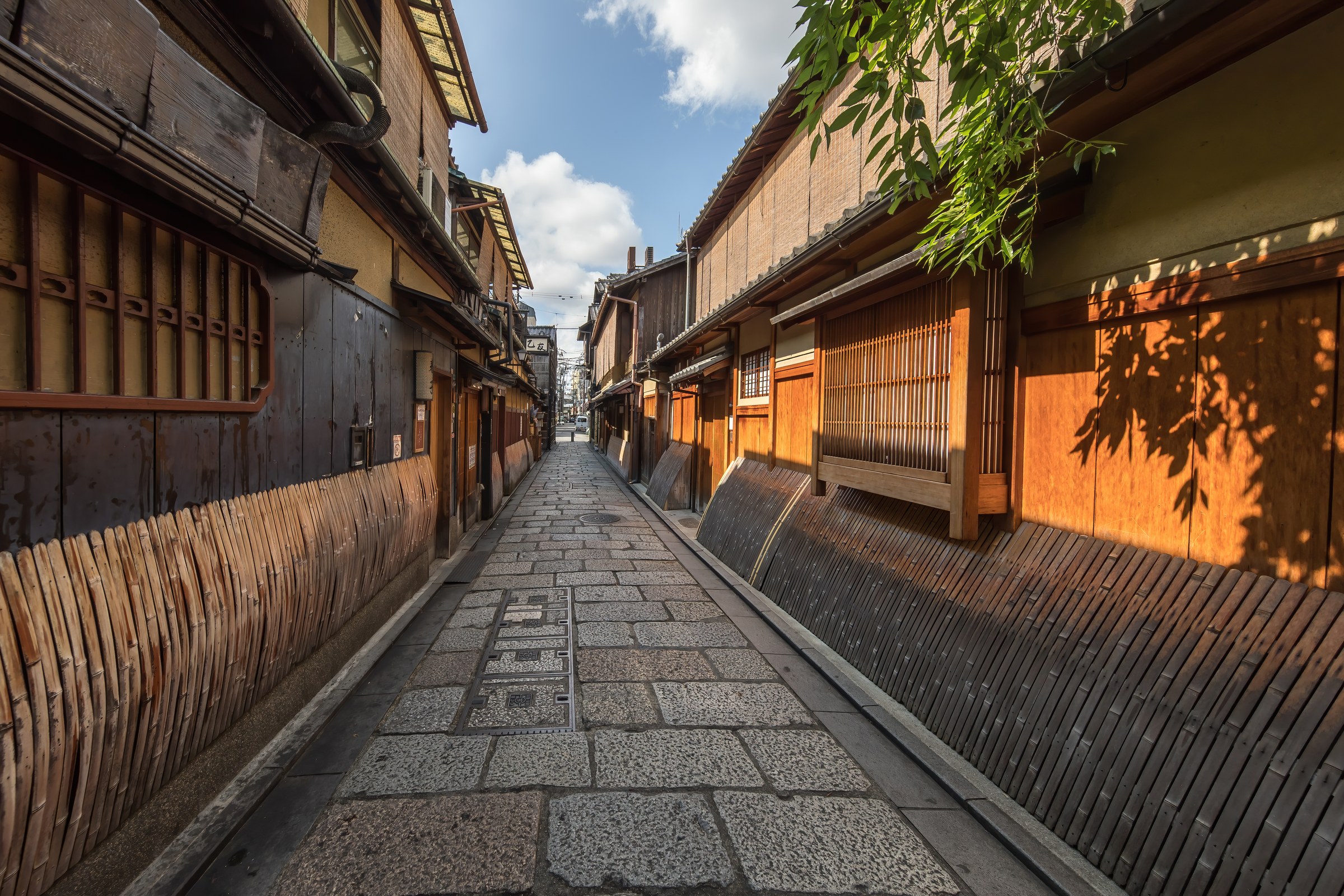
Kyoto, before dawn
Stay in Gion, walk before dawn, and let one temple a day be enough.
Notes from Elsewhere · Published November 2026 · Updated November 2026
Photograph: Basile Morin, via Wikimedia Commons
Kyoto was built in A.D. 794 on the model of the ancient Chinese capital, and it served as the imperial capital of Japan until the middle of the 19th century. A city that held that role for more than a thousand years does not need to be hurried through. The sensible response is a small base, an early start, and a short list: one district, one temple a day, and the rest left for another visit.
Make the base Gion. Kyoto City's official tourism site describes how the area developed as a town near the gate of Yasaka-jinja Shrine, and how it remains a district where geiko and maiko live. Its streets are lined with tea houses and Japanese restaurants, alongside bars, cafes and general stores. That mixture matters. Gion is not a set preserved behind glass; it is a working neighbourhood whose older buildings still do the work they were built for.
The street to learn first is Hanami-koji. Along it, the machiya, the wooden townhouses of the district, present a composed face to the street: timber, lattice and bamboo screens, with little announced and much withheld. It is a handsome arrangement, and a private one. The official guidance is plain on the practical point: Hanami-koji has a lot of traffic, so walk at its edges and keep out of the middle of the road.
For the one temple, choose Kennin-ji, at the quieter end of the district in Higashiyama. The Rinzai Zen head-temple records state that Kennin-ji was established in 1202, with the monk Myoan Yosai, also rendered Eisai, as its founding abbot, and that it was the first major temple associated with the Rinzai Zen school to be established in Kyoto. It began by combining Zen with Tendai and Shingon practice, and became a purely Zen institution under its eleventh abbot, Lanxi Daolong. A morning given to one precinct of that depth is better spent than an afternoon divided among five.
The wider frame explains the discipline. UNESCO's Historic Monuments of Ancient Kyoto, inscribed in 1994, consist of seventeen component parts in Kyoto, Uji and Otsu, covering 1,056 hectares in total. Most of their 198 buildings and twelve gardens were built or designed between the 10th and the 17th centuries. No itinerary absorbs that in a few days, and none should try. One temple a day is not restraint for its own sake; it is the proportion the city itself suggests.
Walk before dawn, then, while the streets are still the residents' own, and walk quietly. Kyoto City asks visitors to keep their voices down in residential areas, to stay out of private property, and to respect the places where photography is prohibited, which in Gion are many. Above all, the geiko and maiko encountered on these streets are on their way to work and to lessons. The appreciation the district deserves is expressed by leaving it, and its people, in peace.
Gion
Stay in or beside the district and let it set the terms. Begin at the gate of Yasaka-jinja Shrine, near which the town first developed, and read the streets from there: tea houses, restaurants and shops behind timber facades.
Treat a sighting of a geiko or maiko as a passing moment, not an appointment. Let them pass, undisturbed.
One temple
Kennin-ji. Give the day's temple the whole morning. Within the precinct, the Abbot's Quarters were presented by Ankoku-ji in 1599, the Dharma Hall was built in 1765, and a tea house built in 1587 is associated with Toyotomi Hideyoshi.
The temple is ranked third of the Kyoto Five Mountain monasteries, and presently has fourteen subtemples within its precincts.
Before dawn
Start early, before the district fills. Dawn suits Gion's materials: stone underfoot, wood and bamboo either side, and the screens still closed against the day.
Photography is prohibited in many parts of Gion. Where it is, put the camera away and look properly instead.
A note on manners, because in Gion manners are the substance. Taking pictures of maiko without permission is strictly prohibited, and the city's guidance asks visitors not to stop, touch or follow geiko or maiko, nor to take their photographs or videos without permission. Enter no private property, block no street, and keep to a quiet voice. None of this diminishes the visit; it is what lets the district's welcome continue.
More places, taken slowly
The other destinations in Places, each at its own pace.
Back to Places