Livigno
A duty-free village at 1,816 metres with serious off-piste on both sides of the valley, and a quieter second life in summer, when the lake and the trails take over.
Places · Published November 2026 · Updated November 2026
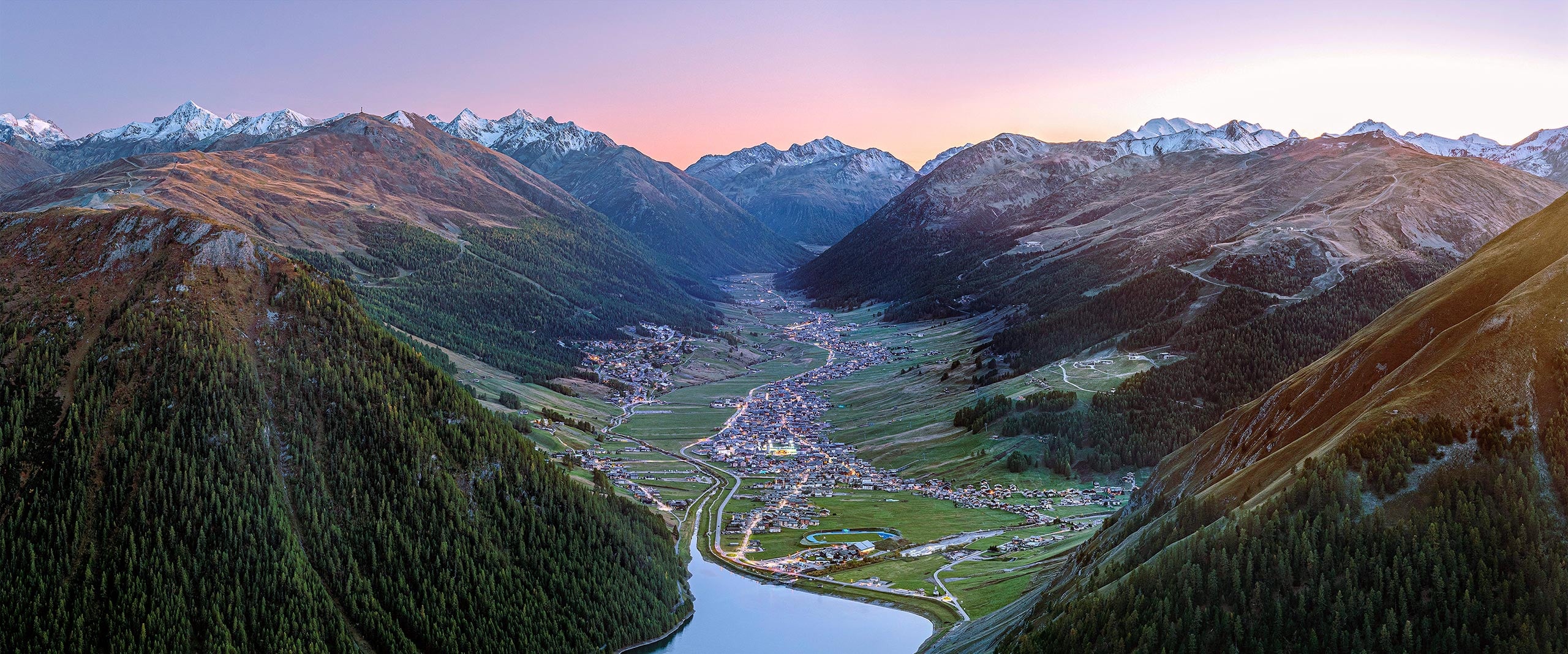
Photograph: Livigno, livigno.eu
Livigno sits at 1,816 metres in a wide, sunny valley on the border with Switzerland, in Lombardy in the Italian Alps. The destination site calls the valley wide, green and very sunny, and records the name it has earned, Little Tibet. Ten peaks above three thousand metres frame it, above spruce, birch, pine and larch. The village runs along the valley floor, slopes rise on both sides, and the lake lies close by.
That shape was once a hardship. Livigno is a borderland, and its own history is plain about isolation and the long winters it imposed. Two dates changed it. In 1952 the Foscagno Pass became passable even in winter. In 1965 work began on the Munt La Schera tunnel, dug to build the Livigno dam and connecting the valley faster to the Canton of Graubünden. The village isolation left behind is still a duty-free area, and that status runs through daily life, most visibly along its shopping mile.
Winter is the first reason to come. The ski area holds 115 kilometres of slopes across 100 square kilometres of skiable terrain: 29 blue runs, 37 red and 12 black. Six gondolas, 14 chairlifts and 12 ski lifts serve them, and the official site stresses the pleasure at the centre of it, a ski-in, ski-out village where the snow is within reach of the hotel door. The coming winter season runs from 28 November 2026 to 2 May 2027, a long run made possible by the altitude.
The two sides give the skiing its character. Carosello 3000 stands on the western side of the valley, Mottolino on the eastern, and moving between them is part of the rhythm of a stay. Groomed slopes suit every level, freeride ground waits in fresh snow, and the snow parks add another register, with an 800-metre area holding more than 60 obstacles and a big air landing more than 50 metres long. Away from the downhill runs, 30 kilometres of cross-country tracks are kept groomed.
The lake is the valley’s quieter half. Close to the village, it offers kayaks, stand-up paddle boats and pedal boats for hire in summer, a calm counterpoint to the pistes above it. It exists because of the dam whose building brought the tunnel, so the water, the road and the modern village belong to one story: a remote valley that opened itself carefully, and kept its scale.
Summer remakes the place without lowering it. The destination counts 3,200 kilometres of GPS-tracked trails for riding, across mountain bike, enduro, cross-country, all-mountain and downhill, e-bikes and road bikes, with bike parks reached by lift. Trekking, hiking and climbing fill the mountains, while golf, tennis and horse riding fill the valley floor. What holds the seasons together is the table and the street: the Tas’T project marks food made in Livigno itself, from bresaola and cheeses to bread and desserts, and the Mus!, the Museum of Livigno and Trepalle, has since Christmas 2015 kept the valley’s tradition in an 18th-century house of masonry and wood. It is a generous composition, and a coherent one.
The village
A long village along the valley floor, and a duty-free one. Its shopping mile mixes local shops with designer boutiques, fashion and sportswear alongside hi-tech goods.
For the valley itself, the Mus!, the Museum of Livigno and Trepalle, keeps its alpine tradition in an 18th-century house.
The two sides
Carosello 3000, on the western side, and Mottolino, on the eastern, share the 115 kilometres between them.
Choose a side for the morning, move across for the afternoon, and ski back toward the village at the end of the day.
The seasons
Winter runs long here, from late November into early May, with 30 kilometres of groomed cross-country tracks beside the downhill slopes.
Summer turns the same ground to riding, trekking and the lake, where kayaks, stand-up paddle boats and pedal boats are for hire.
A note on the appeal. Livigno rewards the unhurried reading of a map: one valley, two mountainsides, a lake, a single long street. Everything is in its place, and the altitude does the rest. Few Alpine villages assemble skiing, water, trails and a working high street as completely, or as calmly.
More places, taken slowly
Gstaad, Megève and the other destinations in Places, each read at the same pace.
Back to Places