Monaco
Two square kilometres, taken at their best hours: the Rock in the early morning, a swim at Larvotto, and the harbour below it all, in May or late September rather than August.
Notes from Elsewhere · Published November 2026 · Updated November 2026
Photograph: Georges Jansoone (JoJan), via Wikimedia Commons
Monaco is a sovereign state of 2.08 square kilometres, the second-smallest in the world after the Vatican, and it has learned to use every metre of itself well. The official figures count 38,857 residents, among them 9,333 Monegasque nationals, along a narrow strip of coast between the mountains and the Mediterranean. Nothing here is far from anything else, and the whole country can be read in a single day, provided the day is ordered properly.
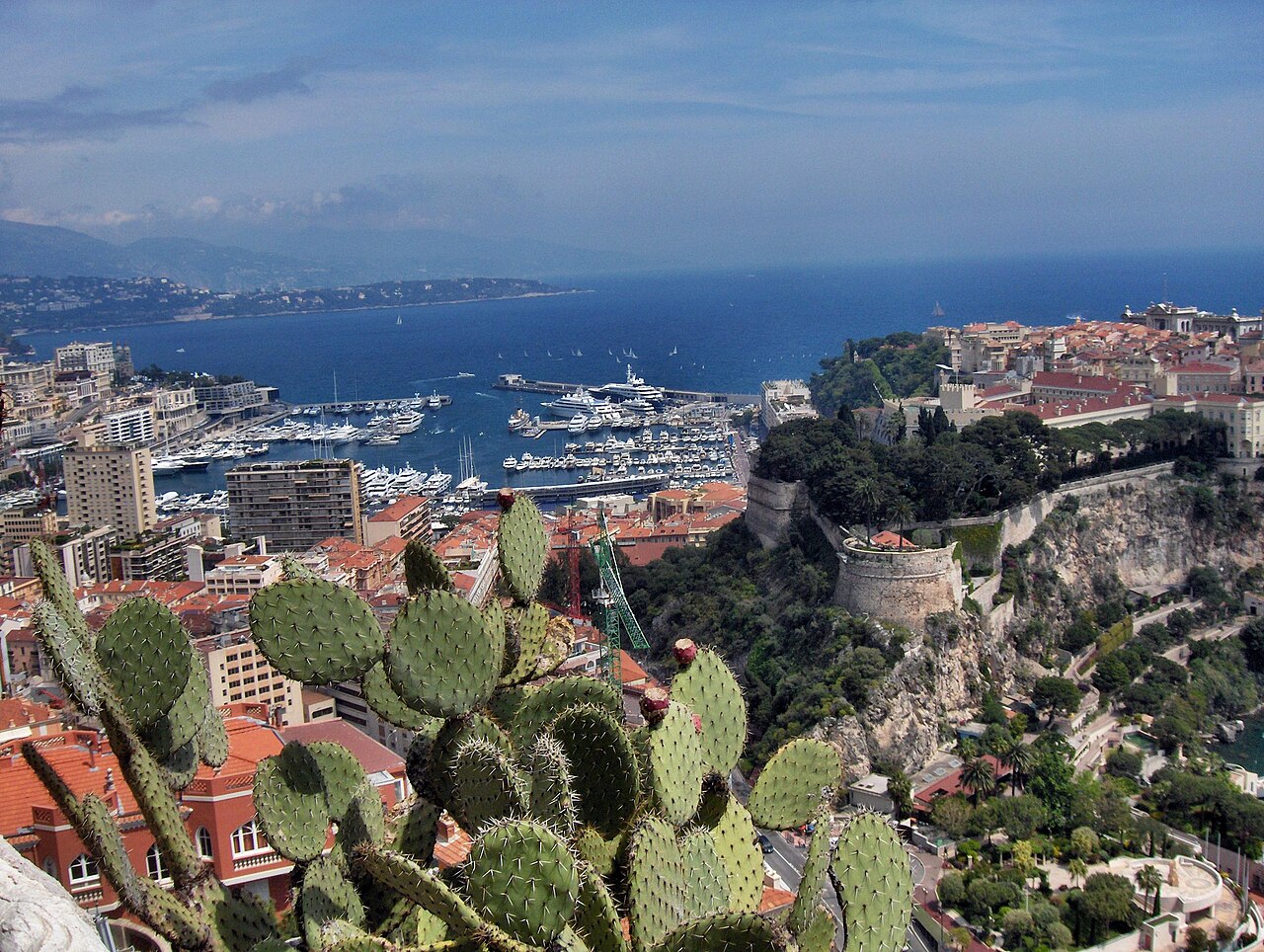
Start on the Rock, and start early. Monaco-Ville, the old town, stands on the headland above the harbour, and the oldest way up is the Rampe Major, a medieval passageway of stone arches and orange cobblestones that climbs directly to the Place du Palais. In the first hours the lanes belong to the people who live and work in them, the old town going about its morning before it becomes a destination. That is the Rock at its best, and it costs nothing but an early alarm.
At the top stands the Prince's Palace, the private residence of the Princely Family. Its State Apartments are open to visitors between March and October, taking in the Cour d'Honneur and the Galerie d'Hercule. Every day at 11.55 am sharp, on the Place du Palais in front of it, the Prince's Carabiniers carry out the changing of the guard. The sensible order is the early walk first and the ceremony second: arrive in good time, watch the guard change, and let the palace set the pace of the late morning.
Along the cliff side of the Rock, overlooking the Mediterranean, stands the Oceanographic Museum, inaugurated on 29 March 1910. It owes its existence to Prince Albert I, who led 28 scientific expeditions before establishing the Oceanographic Institute that still oversees the museum; 6,500 square metres are open to the public. The aquariums are devoted to tropical fish and Mediterranean species, with a shark lagoon and a sea turtle area among them. Nearby, the Saint-Martin Gardens offer Mediterranean planting and open views of the sea, a quiet interval before the walk down.
Below the Rock lies Port Hercule, Monaco's main harbour, a deep-water port set between Monaco-Ville and Monte-Carlo and filled with yachts, sailing boats and smaller craft. Seen from the Rock in the morning, it is still composed: masts, still water, the working geometry of a harbour before the day begins. Later the quays repay a slow circuit on foot, looking back up at the old town above them.
For the swim, go east to Larvotto. The beach there is the principality's main public beach, freely accessible all year round: a stretch of fine pebbles in the Larvotto district, running from the Grimaldi Forum to the Monte-Carlo Sporting complex, with a 300-metre promenade along Avenue Princesse Grace behind it. A supervised swimming area operates in summer, and the clear water gives onto the Monaco Marine Reserve. A morning swim here is the other half of the early start on the Rock.
The Rock
Monaco-Ville, the old town on the headland: the Rampe Major up, the palace square, and the cathedral, built in 1875, which holds the tombs of deceased princes.
Go before the harbour wakes. By 11.55 am, the morning's quiet has done its work.
The harbour
Port Hercule, the deep-water main harbour between Monaco-Ville and Monte-Carlo, home to yachts, elegant sailing boats and smaller craft, with the district of La Condamine at its head.
Fort Antoine, an early 18th-century fortress overlooking the port, hosts open-air performances in July, facing the Mediterranean.
The season
Take May or late September over August. The light is long, the sea is the same sea, and the principality runs at its ordinary pace rather than its peak one.
In those months the Oceanographic Museum is open from 10 am to 7 pm.
A note on names. Monaco is the country, the principality as a whole; Monte-Carlo is one of its districts, as Fontvieille and La Condamine are. In two square kilometres, knowing which part of the whole is being spoken of is most of knowing the place.
Small places, taken slowly
Gstaad, Megève, the Amalfi Coast and the rest of the Maison's places, each considered at its best hour.
All places