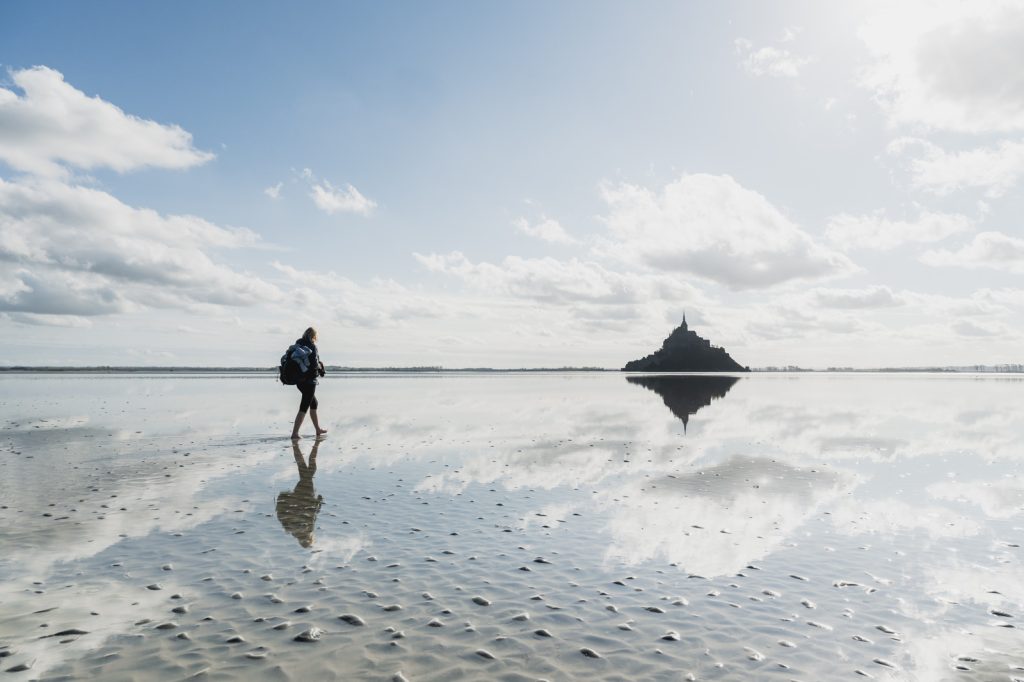
Normandy, by the tide
Mont Saint-Michel at low tide, Deauville out of season, and lunch where the oysters come from the producers. The tide tables set the itinerary, and the weather is part of the arrangement.
Notes from Elsewhere · Published November 2026 · Updated November 2026
Photograph: E. Berthier, via Normandy Tourism
Normandy is best understood from its western edge, where the land gives up gradually. At Mont Saint-Michel the sea withdraws as far as 15 kilometres at low tide, leaving wet sand and channels around a granite rock, and then returns. The bay holds the highest tides in continental Europe, up to 15 metres between low and high water. Nothing here is arranged to the clock. It is arranged to the moon.
At the top of the rock, reached through a village that is freely accessible at any hour, stands the abbey. The ticket gives access to all of its rooms, and the entrance opens onto the west terrace, where the whole bay is laid out below. Go early or late, and allow for the climb, up a great many steps.
The crossing of the bay on foot is the oldest way to arrive, in the tradition of the pilgrims who walked the shore to the Mont. It is also the one part of the journey that must never be improvised. The official tourist office is plain about it: it is extremely dangerous to venture alone into the bay, even close to the Mont. Certified guides lead the walk all year round, reading the channels and the quicksand and setting the hour by the tide.
The weather deserves a mention of its own. The abbey itself warns that conditions at the Mont are very changeable, and advises waterproof, windproof and warm clothing in winter. That is not a defect: the same Atlantic air gives the coast its light and silvers the sand at low water. Pack for the changeable version.
East along the coast, Deauville rewards the out-of-season visit. Normandy Tourism notes that the town can be enjoyed all year round, and that in winter the boardwalk and the sunsets come in a quieter setting. Les Planches, the wooden boardwalk of 1923, runs the length of a 2-kilometre beach past 450 Art Deco beach huts carrying the names of actors and directors from the town's American Film Festival. Behind them sits the Pompeian bathing area, all fountains and mosaics. None of it needs summer.
The journey ends at a table in Cancale, at the western end of the same bay. At the end of the port, at the foot of the Houle lighthouse, the oyster market sells direct from the producers' farms, and the oysters can be eaten on the spot, all year round. Order both kinds if both are offered: the cupped oyster, and the rarer flat oyster, with its hazelnut note, farmed in pockets on tables on the foreshore.
The bay
Time the Mont to the tides, not the clock. The strongest tides fall 36 to 48 hours after the full and new moons; be in place two hours before high water.
Cross on foot only with a certified bay guide. The tourist office calls going alone extremely dangerous.
Deauville, quiet
Walk Les Planches out of season, when the 1923 boardwalk and the named beach huts have room around them.
Then turn inland to Deauville-La Touques, racing since 1864, with meetings throughout the year and polo inside the course.
The oysters
At Cancale, buy at the oyster market at the foot of the Houle lighthouse, direct from the producers, and eat them there.
Ask for flat oysters alongside the cupped. They are the rarer of the two.
A note on sequence. The coast reads west to east: the Mont and its bay first; Deauville second, taken slowly and out of season; Cancale last, at lunch, facing the water the oysters grew in. Each place is governed by the same sea.
More of the coast, taken slowly
Gstaad after the lifts close, and the other destinations in the series.
All places