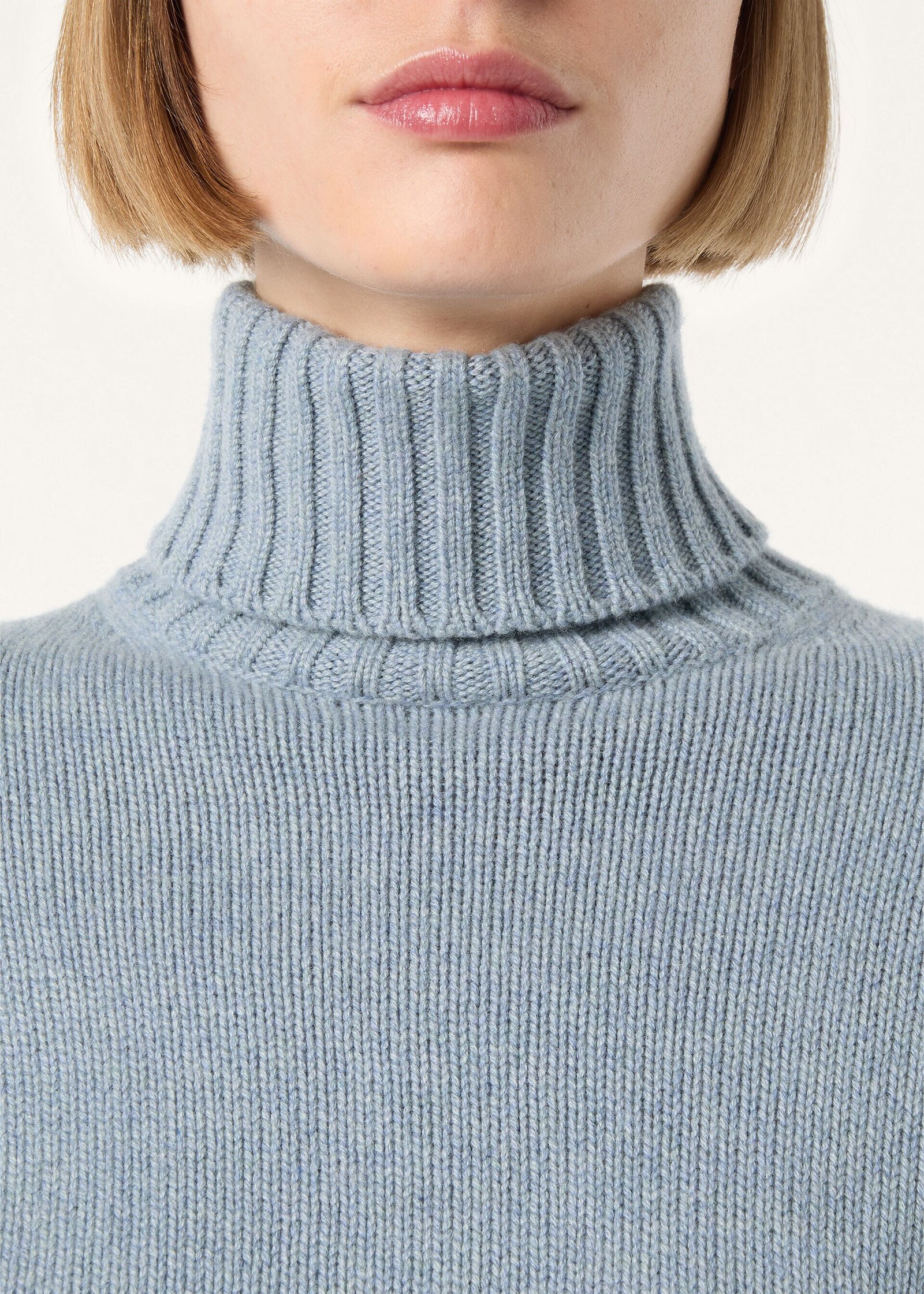
Roll-neck, baby cashmere
One garment from the Maison’s wardrobe list, examined closely: a Loro Piana roll-neck in undyed ecru, and the rare fibre that makes it possible.
The Atelier · Published November 2026 · Updated November 2026
Photograph: Loro Piana
The wardrobe notes in The Atelier keep a short list, and near its top sits one Loro Piana roll-neck in undyed ecru. It earns its place by being plain in the best sense. The colour is close to the colour of the fibre itself, the knit is smooth, and no label faces outward. What decoration it has is the roll of its collar, and the quality of what it is made from.
That material is baby cashmere, and its story begins far from any wardrobe. The Capra Hircus goats are native to the mountainous regions of Asia, especially Mongolia and Inner Mongolia, where the land is largely desert, food and water are scarce, and torrid summers stand against frigid winters. To survive there, the goats grow a coarse outer coat over a fine underfleece, the douvet, whose fibres trap air and hold body temperature steady against the cold.
Baby cashmere is that underfleece, taken from kids. Loro Piana gathers it only while the kid is less than a year old, and the house’s own account is plain about the arithmetic: each animal gives just 30 grams of fibre, measuring 13.5 microns in diameter, a micron being a millionth of a metre, and the fibre can be gathered only once in the animal’s life. It took ten years to persuade a select number of herders to separate the kids’ fibre from the adults’, and years of experiment in Italy before the working of it was perfected. Knitwear came first.
The fineness is not a statistic for its own sake. Loro Piana attributes the fibre’s softness against the skin to the diameter itself, rather than to any finishing treatment, and a fibre this fine asks to be knitted plainly and worn close. It began as insulation, grown by an animal that needed it, so a light layer carries a warmth its weight does not predict. Few materials make so strong a case with so little show.
The roll-neck is the right form for it. In its Parksville roll-neck, Loro Piana renders baby cashmere in a smooth plain knit with a ribbed roll collar, ribbed cuffs and hem, long sleeves and a regular fit, made in Italy. The collar does the work of a scarf without adding a second garment, and the clean line is made for layering in cold weather, the use the house names first for the design. In undyed ecru it sits quietly with flannel, with charcoal, with denim, and asks nothing of the rest of the wardrobe.
The fibre
The underfleece of Capra Hircus goat kids, gathered before the first birthday and only once in the animal’s life.
Thirty grams per kid, at 13.5 microns in diameter, from the mountain country of Mongolia and Inner Mongolia.
The garment
A roll-neck in a smooth plain knit, as in Loro Piana’s Parksville: ribbed collar, cuffs and hem, long sleeves, a regular fit, at gauge 5.
The layer that replaces a scarf, worn under a coat when the weather turns.
The keeping
Rest it: never wear it two days in a row, so the fibres regain their natural structure.
Wash by hand, or on a hand-wash cycle, after four or five wears, separately or with like colours. Dry flat between two soft towels, away from direct sunlight, steam to reshape, and store it folded with cedar balls or moth repellent, in a dry place away from heat and light.
A note on choosing the undyed one. A garment with no label facing outward and no colour added puts its whole case on the material and the making, and baby cashmere, gathered once and in grams, is equal to that scrutiny. It is a generous way for a maker to work, and a comfortable one to wear: nothing to announce, everything to feel.
Back to the wardrobe
Fewer things, better made, worn until they are yours: tailoring, knitwear and the makers behind both.
Return to Wardrobe