Bordeaux
Stay in the city, drive to Saint-Émilion in the morning, and let one estate visit a day be the whole plan. The right bank rewards patience.
Notes from Elsewhere · Published November 2026 · Updated November 2026
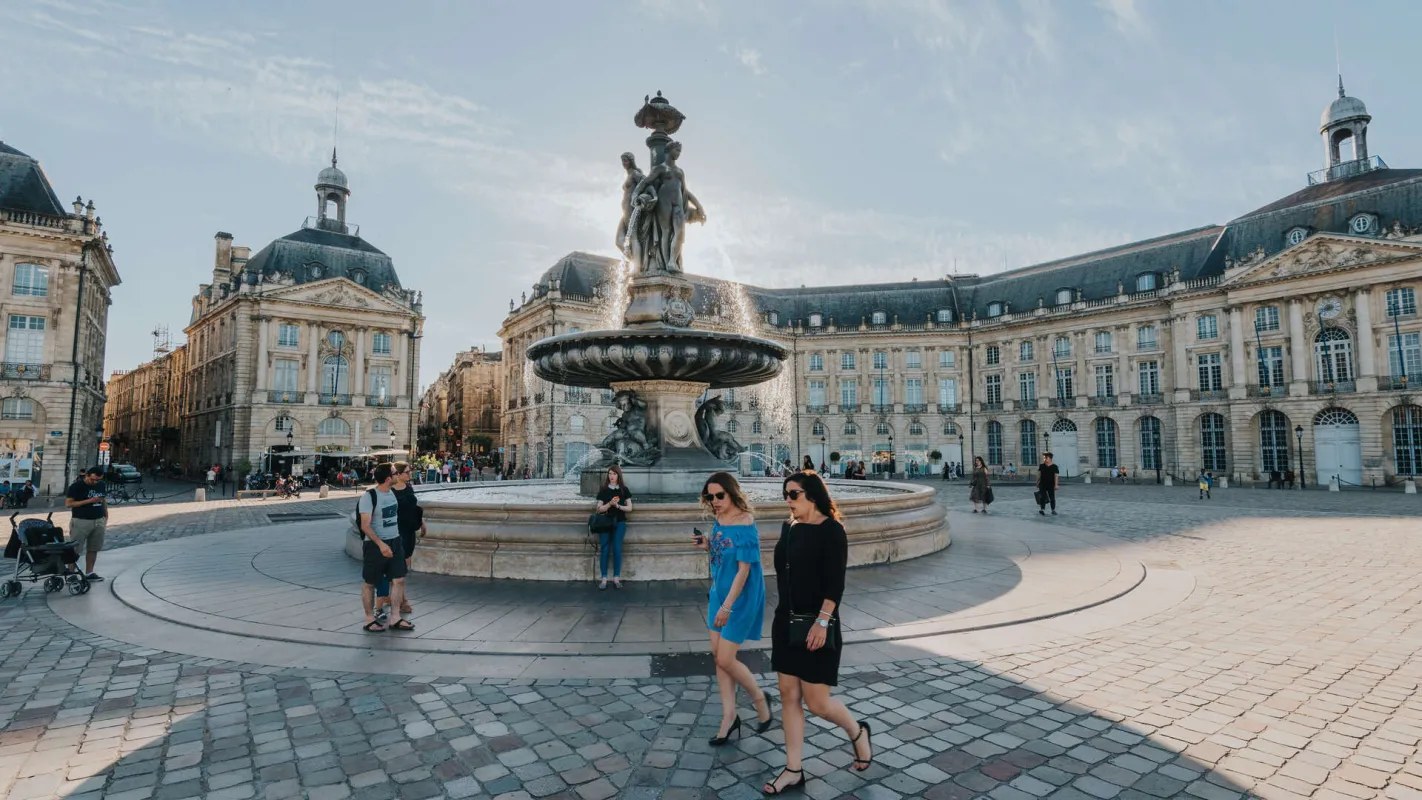
Photograph: Nicolas Duffaure, Bordeaux Tourism
The sensible way to take Bordeaux wine country is to sleep in the city. Bordeaux is a port city on the Garonne in south-west France, and the city itself is the first subject. In 2007 UNESCO inscribed Bordeaux, Port of the Moon, on the World Heritage List as an inhabited historic city: an outstanding urban and architectural ensemble created in the age of the Enlightenment, whose values continued up to the first half of the 20th century, with more protected buildings than any other French city except Paris. Bordeaux Tourism puts the listed perimeter at 1,810 hectares, almost half the surface of the city. Stay inside it, and the vineyards become a day’s excursion from a real place.
Begin at the river, because the city did. UNESCO traces the urban plans and ensembles from the early 18th century onwards, and reads in them an exceptional unity of classical and neoclassical building. That unity is clearest along the quays of the Garonne, where the facades follow the bend that gave the Port of the Moon its name. At the centre stands Place de la Bourse, built between 1730 and 1755 and previously known as Place Royale, with the Fountain of the Three Graces, added in 1869, at its centre.
Across from the square, the river front has a contemporary layer. The Miroir d’Eau was inaugurated in 2006 as a key element of the redevelopment of the quayside. Bordeaux Tourism describes it as the largest water mirror of its kind, 3,450 square metres of granite under a film of water 2 centimetres deep, reflecting the facades of the Bourse before giving way, in cycles, to mist. Go early, when the reflection is complete, and again in the evening.
Behind the quays lies Saint-Pierre. Its church, Église Saint-Pierre, stands tucked into a labyrinth of narrow streets, but it was built in the 14th and 15th centuries beside the Devèze river, close to its meeting with the Garonne, when it was a port-side church; it was rebuilt from 1358 onwards. Nearby, Place du Parlement was created in the quarter in 1754, lined with facades from the first half of the 18th century, its fountain added in 1865. This is the quarter to return to at the end of the day: small squares, old streets, and dinner taken slowly.
In the morning, drive east. Saint-Émilion lies about 40 kilometres from the city, roughly 45 minutes by car, on the right bank. Bordeaux Tourism counts more than 900 winegrowers in the region, working a mosaic of terroirs on predominantly clay and limestone soils, where Merlot is complemented by Cabernet Franc and Cabernet Sauvignon. The town is an age-old medieval town, and its vineyard was the first wine-growing landscape to be listed by UNESCO. The Maison follows that landscape at picking time in its Experiences piece on harvest week in Saint-Émilion.
Then hold the day to one estate. Estate visits are arranged ahead, by appointment, and a single well-chosen visit is enough: the chai, the rows, the tasting, and no clock pressing on any of it. Further appointments turn a day in wine country into a schedule, and the right bank does not reward hurry. Leave the rest of the day to the town and to lunch, and let the city have the evening.
The city
Stay within the listed perimeter: 1,810 hectares, inscribed by UNESCO in 2007, holding 347 listed buildings by UNESCO’s count.
The city is the base, not a stop between vineyards.
The quays
Walk the Garonne front from Place de la Bourse, built 1730 to 1755, to the Miroir d’Eau opposite, inaugurated in 2006.
Early morning and evening are its best hours.
One estate a day
Drive to Saint-Émilion in the morning, keep the appointment booked in advance, and make that visit the whole plan.
One estate, the town, a long lunch, and back to the city for dinner.
A note on patience. Bordeaux has been a place of exchange for more than 2,000 years, on UNESCO’s account. A city taken on foot, one estate taken properly, and the quays again at dusk is the region at its own pace.
More places, taken slowly
Gstaad after the lifts close, the Amalfi Coast by boat, and other places returned to.
Back to Places