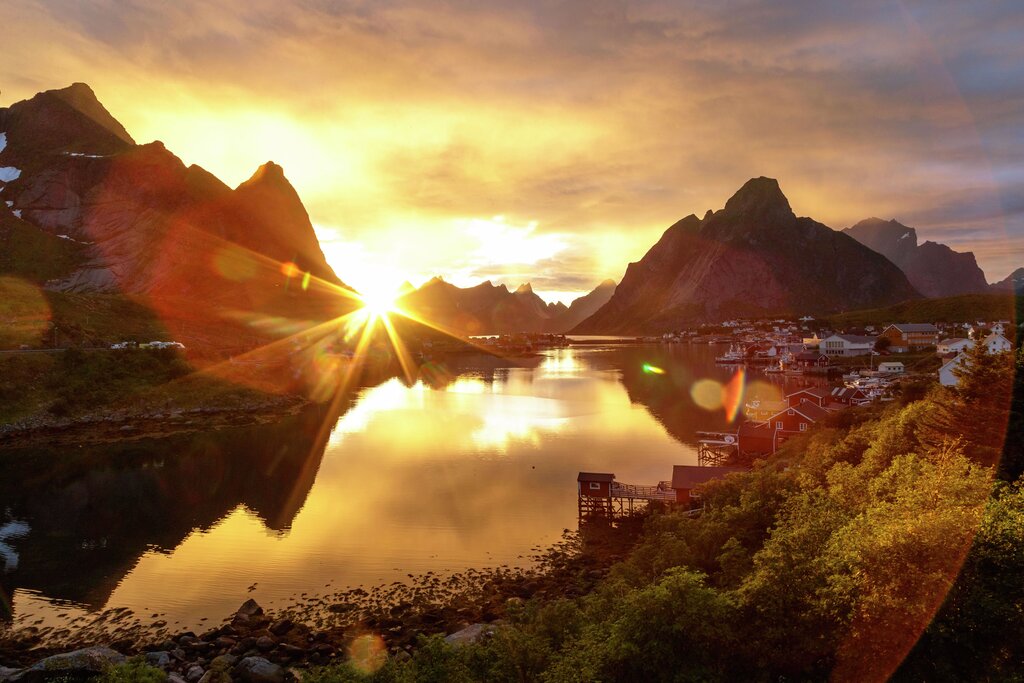
Lofoten
An archipelago above the Arctic Circle built around a winter fish: red fishermen's cabins at the water's edge, cod landed in the harbours below, and a year divided by light.
Notes from Elsewhere · Published November 2026 · Updated November 2026
Photograph: Hallvard Kolltveit, Destination Lofoten
The Lofoten Islands are spread across the Norwegian Sea in Nordland county, above the Arctic Circle at about 68 degrees north. It is a landscape of pointed mountains rising straight from the shore, deep fjords, long beaches and small fishing villages. Thanks to the Gulf Stream, the climate is much milder than in other places at the same latitude, and the fishery is a main reason people have lived here for thousands of years.
One road does most of the work. The E10 is the single main artery that ties the islands together, and the Norwegian Scenic Route Lofoten follows it for around 230 kilometres between Raftsundet and Å, with detours to villages including Nusfjord and Henningsvær. Since 2007 the Lofast link has connected the islands to the mainland by road in the east; in the west, the Bodø to Moskenes ferry makes the other approach.
Reine, near the western end, shows the pattern clearly. The village is a chain of islands linked by bridges and winding roads, with Vestfjorden on one side and Reinefjorden and its high mountains on the other. About 300 people live there; it is the municipal centre for Moskenes, and fish reception and processing remain the primary industry. Further east, Henningsvær sits on skerries with the mountains behind it, its harbour now shared by fishing boats, galleries and restaurants.
The red cabins at the water's edge are the islands' signature building, and they began as shelter. A rorbu was lodging for the fishermen who came from across Norway for the Lofotfiske, the winter cod season, rented from the fishing station owner who held the village land. It was common for up to twelve men to share a cabin furnished with just four bunks. The oldest such cabin, Skrovabua, dates from 1797 and stands at the Lofoten Museum in Storvågan, at Kabelvåg. Many rorbuer are now let to travellers, in harbours the boats still use.
The fish is skrei, the Northeast Atlantic cod that migrates from the Barents Sea to spawn in the Vestfjord. Visit Lofoten dates the fishery from January to April, carried on in much this way since before the Viking Age. In season the restaurants build menus around the fresh catch, the cod itself and also the tongues, liver and roe. Along the shore, more of the catch hangs on wooden racks, the hjell, drying into stockfish, traded from here for a thousand years and still one of Norway's oldest export goods.
Above the villages, the calendar is set by light. The midnight sun runs from 28 May to 14 July, seen best from the outer, northern side of the islands or from a mountain top. At the other end of the year, the arctic night lasts from around 7 December to 5 January, when the sun does not rise and midday glows in the deep blue, rose and gold of the blue hour. Between those poles come the northern lights, visible from late August to early April beneath the auroral oval. The place rewards being read from the water as well as from the road: Lofoten under canvas follows the same islands under sail.
The cabins
Stay in a rorbu and the history stays practical: a small wooden house at the harbour, built for the season's crews, now kept for travellers and fishermen alike.
Nusfjord, one of the oldest and best-preserved fishing villages in Lofoten, shows the type at its clearest.
The cod
Order skrei in season, from January to April, landed fresh in the Vestfjord harbours and cooked whole, tongues, liver and roe included.
In March, Svolvær hosts the World Championship in Cod Fishing, held since 1991, with around 600 anglers taking part.
The light
Choose the season by the sky: midnight sun from late May into July, the blue hour of the arctic night in December, or the northern lights from late August to early April.
At Svolvær, mountains block the midnight sun; the outer coast is where to watch it.
A note on conduct. These are small, working communities; the harbours, racks and boats are somebody's livelihood rather than a backdrop. Visit Lofoten makes the same point about Reine: respect residents' privacy, and photograph the stockfish without touching it, since it is food.
More places, taken slowly
Gstaad after the lifts close, Geirangerfjord before the ships, and other destinations taken out of season.
All places