South Tyrol
Pinot bianco above Bolzano, saunas at altitude, and hotels run by families, not groups: wine in the valleys, pasture above them, and one mountain culture spoken in more than one language.
Destinations · Published November 2026 · Updated November 2026
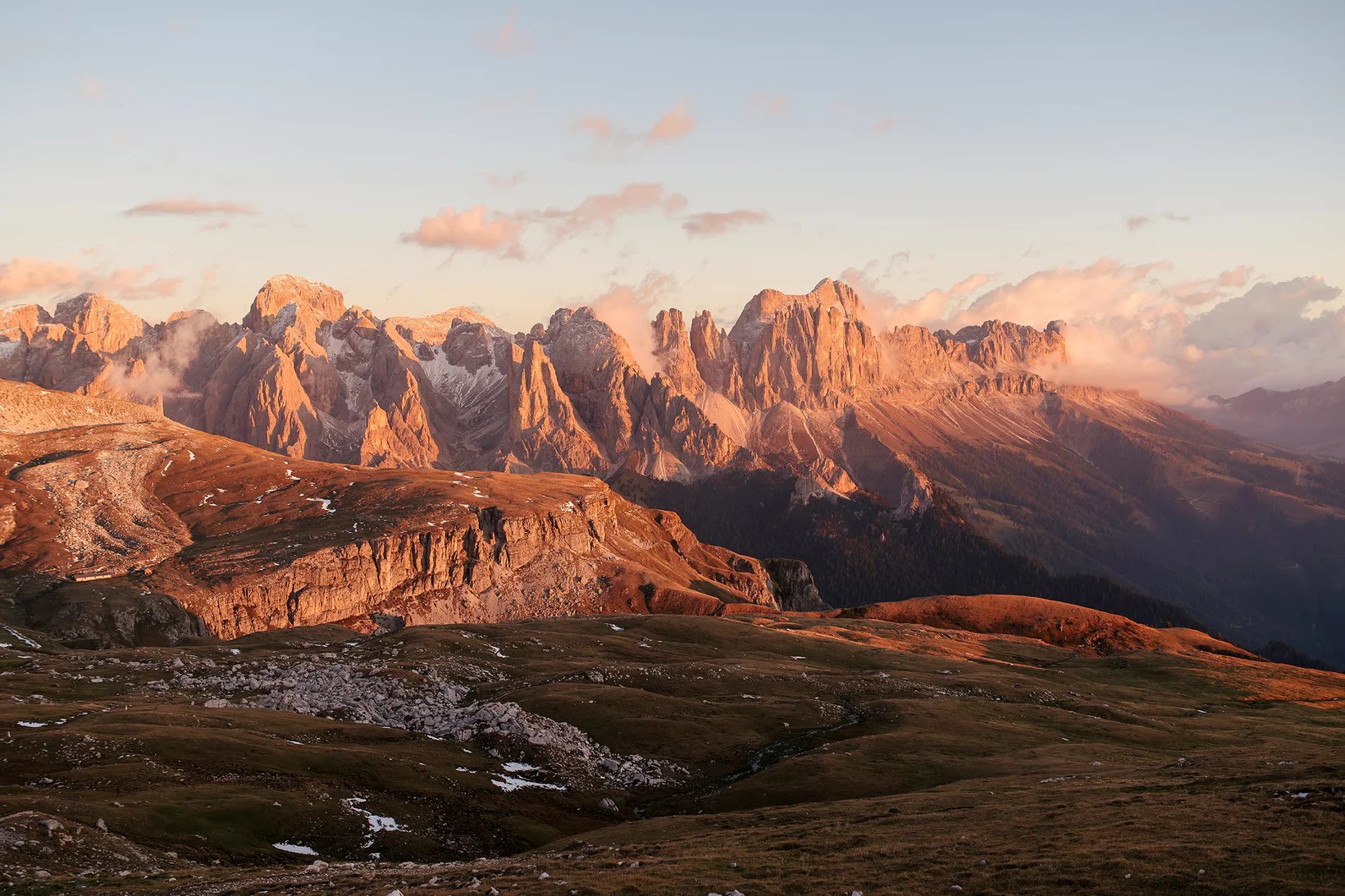
Photograph: IDM Südtirol-Alto Adige
South Tyrol sits on the southern side of the Alps, where the Dolomites meet sweeping valleys and terraced vineyards. The official destination site, IDM Südtirol-Alto Adige, describes a region of sharp contrasts: altitude runs from around 200 metres in the southern valleys to over 3,900 metres at the Ortler, and the climate carries both Alpine freshness and mild Mediterranean currents.
The mountains come first. In 2009 the nine sub-areas of the Dolomites were designated a UNESCO World Heritage Site, and four of the nine lie in South Tyrol, among them the nature parks of the Three Peaks, Fanes-Sennes-Braies, Sciliar-Rosengarten and Puez-Odle, and the GeoParc Bletterbach. About 30 million years ago the European and African plates collided and lifted the range out of the sea. At sunset the stone answers with colour, the Rosengarten glowing red in the phenomenon Bolzano knows as Enrosadira.
Bolzano, written Bolzano/Bozen in the region's double naming, is the provincial capital and the natural base. Its old town is defined by the Lauben, the arcades that have served as its commercial centre since the Middle Ages, and a short walk away the South Tyrol Museum of Archaeology is the permanent home of Ötzi the Iceman, the glacier mummy from the Copper Age. Cable cars leave the centre for the plateaus of Ritten, Jenesien and Kohlern.
That double name is the region in miniature. German, Italian and Ladin are all official languages here, a fact visible in daily life and in the cuisine, which sets Alpine dishes such as Schlutzkrapfen and dumplings alongside pasta and risotto. It is a border country that has made a settled culture out of being two things at once, and then a third.
Below, in the valleys, is the wine. South Tyrol is the smallest wine region in Italy, and one of its most concentrated: families have grown wine here for 2,500 years, and around twenty grape varieties grow on 5,800 hectares between 200 and 1,200 metres, with 98 per cent carrying the DOC seal. The white wines are fresh and mineral, Pinot Blanc among the varieties the official wine pages put first. For reds, Pinot Noir, known locally as Blauburgunder, covers 617 hectares mainly in the south, the Überetsch, the Bozen valley basin, the Adige Valley and the Vinschgau, while Lagrein, one of the oldest varieties in South Tyrol, comes from Bolzano itself. The Alto Adige Wine Road strings the cellars together.
Above the vineyards, the working landscape changes. In the lower valleys the holdings sit among vines and apple orchards; higher up, towards the Dolomites and the Ortler, dairy farming and livestock take precedence, and the farm holiday becomes the region's most direct form of hospitality. The Maison has written separately about the farm table in South Tyrol, where the menu is the holding itself. The hotels follow the same pattern: family ownership, many houses run by the same families for generations, built in local wood and stone around the Stube, the wood-panelled parlour. A sauna at altitude after a day on the high paths completes the structure: rest above, wine below, and a family name on the door.
Two languages
German and Italian run side by side through everyday life, in place names, menus and street signs: Bolzano/Bozen, Meran/Merano, the Adige that is also the Etsch.
Ladin is the third official language, rooted in the Dolomite valleys.
The wine below
Around twenty varieties on 5,800 hectares between 200 and 1,200 metres, in Italy's smallest wine region, 98 per cent under the DOC seal.
Pinot bianco for the whites, fresh and mineral; Blauburgunder on 617 hectares mainly in the south and the Bozen valley basin, and Lagrein from Bolzano for the reds.
The farms above
The holdings change with altitude: vineyards and apple orchards in the lower valleys, dairy farming and livestock higher up.
A farm holiday puts guests inside that working order, at a table fed by the holding, in a house run by the family that farms it.
Read the region vertically and it resolves. Begin in Bolzano with Ötzi and the arcades, follow the Wine Road through the pergolas, and finish on the high pastures, where the farms look back down at the vineyards.
More places, taken slowly
Gstaad after the lifts close, Napa Valley in harvest, and the other destinations in the Maison's Places.
Back to Places